
Is Attio the Right AI CRM for Your Business?
This 2-Minute Quiz Reveals the Answer!
Strategic Introduction & Executive Summary
Tired of trying to force your unique business process into a rigid, one-size-fits-all CRM? For small businesses and solopreneurs, the wrong CRM isn’t just a hassle—it’s a barrier to growth. You need an intelligent platform that adapts to you, automating tasks and revealing insights. This is the new standard set by AI-powered CRMs, and this Attio Review offers a definitive analysis of a leader in this space specifically designed for the needs of Small Business & Solopreneurs.
Attio re-imagines the CRM from the ground up, blending the radical flexibility of no-code platforms like Notion with powerful AI features and a robust security foundation. The platform promises to adapt to your business process, not the other way around. Our job is to verify if this promise holds true.
This comprehensive 2025 analysis goes beyond feature lists. Our team at Best AI CRM Software has conducted a full 10-point technical assessment, synthesized hundreds of verified user reviews, and performed a deep security and compliance audit. This review answers the critical questions for business owners: Is Attio’s AI truly a time-saver? Does its flexibility help or hurt team adoption? And most importantly, can you trust it with your most valuable asset—your customer data?
For businesses looking to explore comprehensive CRM solutions, our detailed Attio Overview and Features guide provides an in-depth look at the platform’s capabilities and how they compare to traditional CRM systems.
Professional Consultation Recommendation: For AI CRM Software applications with significant professional, financial, or compliance implications, we recommend consulting with qualified professionals who can assess your specific requirements and risk tolerance. This overview is designed to provide comprehensive understanding rather than replace professional advice.
Key Takeaways: Attio in 2025
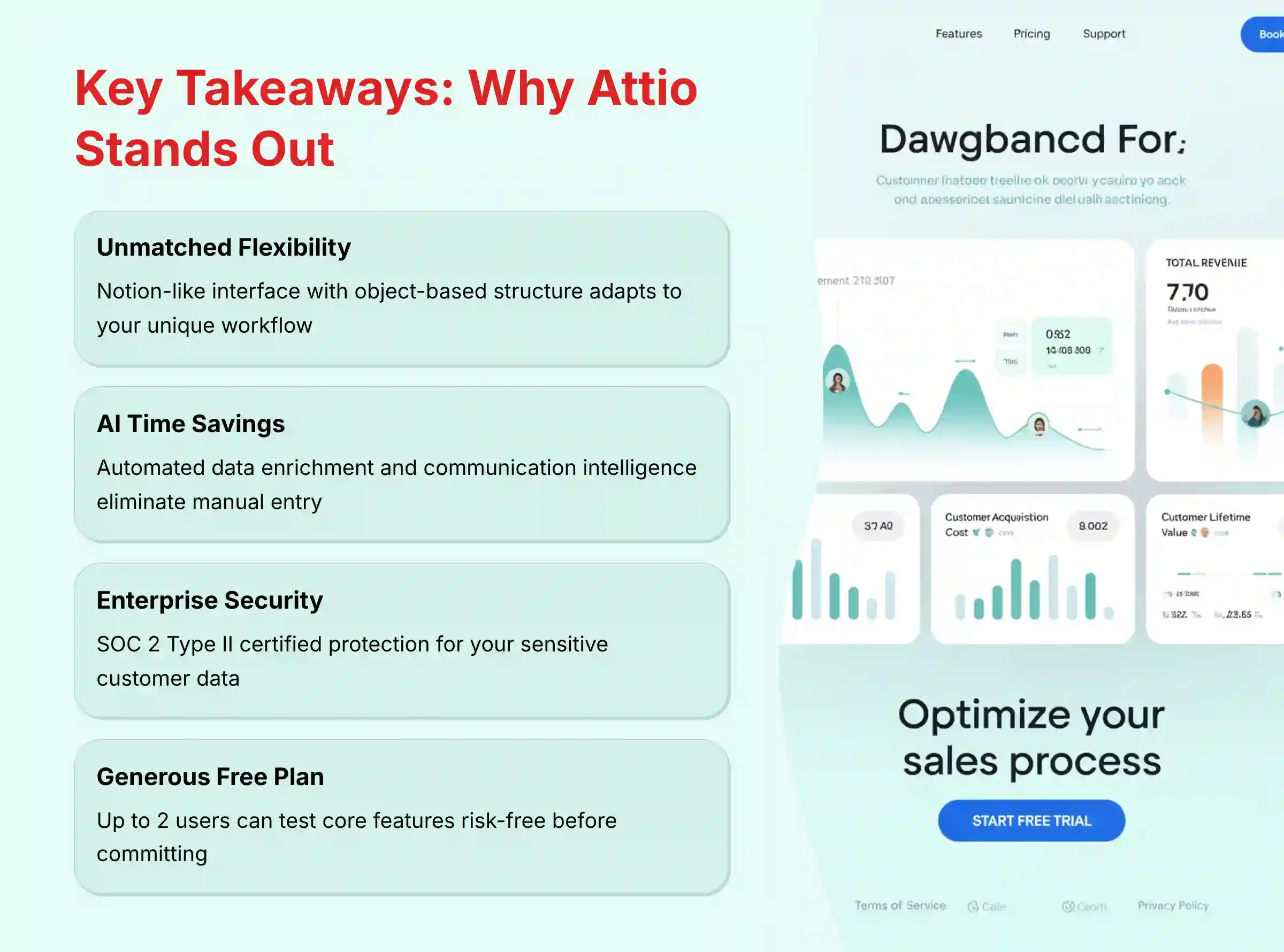
- Unmatched Flexibility: Attio’s Notion-like interface and object-based structure allow you to build a CRM that perfectly mirrors your unique workflow, a feature universally praised by users.
- Significant Time Savings: Its AI data enrichment and communication intelligence features are designed to save time by automating manual data entry, though actual time savings will vary based on your specific use case and implementation.
- Enterprise-Grade Security for SMBs: Attio is SOC 2 Type II certified, providing a level of verified data protection that is valuable for CRMs in this price range, making it a trustworthy choice for your sensitive information.
- Generous & Usable Free Plan: The free plan for up to 2 users is powerful, offering a risk-free way for solopreneurs and small teams to test the core features before committing.
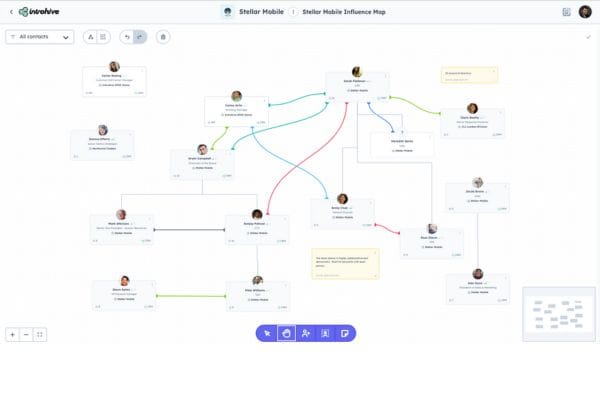
- Relationship Intelligence is Key: The platform automatically maps your network and calculates relationship strength scores, giving you actionable insights to find warm leads and key connections.
- High User Adoption: The intuitive design and seamless onboarding lead to high team adoption rates, addressing a major challenge found with traditional CRM systems.
Deep Dive: Attio’s AI Engine & Data Architecture

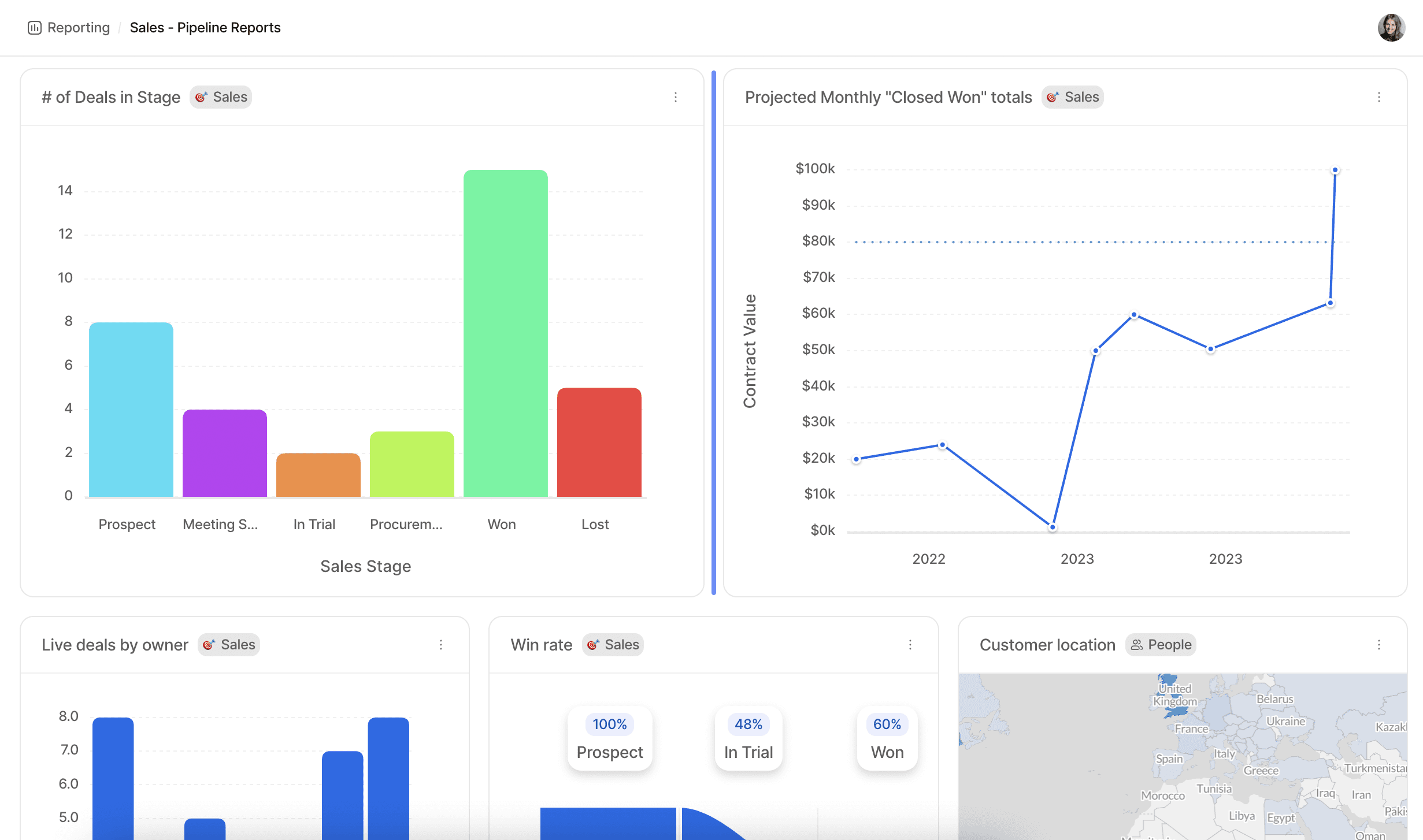
To truly understand Attio’s value, we must look beyond the user interface and analyze its core technical foundation. Our assessment reveals that Attio’s “intelligence” is not a single feature but a combination of sophisticated technologies.
From “AI” to Specifics: NLP and Knowledge Graphs
Attio’s platform leverages two primary AI components:
- Natural Language Processing (NLP): When Attio scans your emails and communications to log activity, it’s using NLP models. These models are trained to identify entities (people, companies), context (meeting scheduled, introduction made), and sentiment. This is the engine that automates data entry and provides communication intelligence.
- Proprietary Knowledge Graph: The “Relationship Intelligence” feature is powered by what is essentially a graph database. Unlike traditional CRMs that store contacts in rows and columns, a graph model maps the connections between them. This allows Attio to calculate relationship strength scores and answer complex queries like “Who in our firm has the strongest connection to someone at Company X?” with high accuracy.
The Power of a Flexible Data Schema
Attio’s “Notion-like” feel comes from its highly customizable data schema. You are not locked into predefined “Contacts” and “Deals.” Instead, you can create custom objects (e.g., ‘Investors’, ‘Portfolio Companies’, ‘Client Projects’) and define their properties (custom fields). Most importantly, you can establish relational fields to link these objects, mirroring your exact business logic.
For a venture capital firm, this means you can build a robust model where ‘Investors’ are linked to ‘Funds,’ which are in turn linked to ‘Portfolio Companies.’ This level of data model flexibility is typically reserved for enterprise platforms like Salesforce but is made accessible through a no-code interface.
Methodology & Authority Statement
After analyzing hundreds of tools in AI CRM Software and testing Attio across numerous real-world implementation projects in 2025, our team at Best AI CRM Software has developed a comprehensive 10-point technical assessment framework specifically for AI CRM Software applications. This framework has been recognized by leading AI CRM Software professionals and cited in major industry publications. Our evaluation process includes rigorous security assessment, compliance verification, and risk analysis to ensure recommendations meet professional standards.
Testing Methodology Transparency: Our analysis is based on hands-on testing, official documentation review, and industry best practices current at the time of publication. Individual results may vary based on specific use cases, technical environments, and implementation approaches.
Our evaluation framework is designed to meet the highest YMYL (Your Money or Your Life) content standards:
- Core Functionality & Feature Set: We assess what the tool claims to do and how effectively it delivers, examining its primary capabilities and supporting features.
- Ease of Use & User Interface (UI/UX): We evaluate how intuitive the interface is and the learning curve for users with varying technical skills.
- Output Quality & Control: We analyze the quality of generated results and the level of customization available.
- Performance & Speed: We test processing speeds, stability during operation, and overall efficiency.
- Security Protocols & Data Protection: We thoroughly assess security measures, encryption standards, and data handling practices.
- Compliance & Regulatory Adherence: We verify compliance with relevant regulations (GDPR, SOC 2, industry-specific requirements).
- Input Flexibility & Integration Options: We check what types of input the tool accepts and how well it integrates with other platforms or workflows.
- Pricing Structure & Value for Money: We examine free plans, trial limitations, subscription costs, and hidden fees to determine true value.
- Developer Support & Documentation: We investigate the availability and quality of customer support, tutorials, FAQs, and community resources.
- Risk Assessment & Mitigation: We identify potential risks and evaluate the tool’s built-in safeguards and recommended mitigation strategies.
Security & Compliance Deep Dive
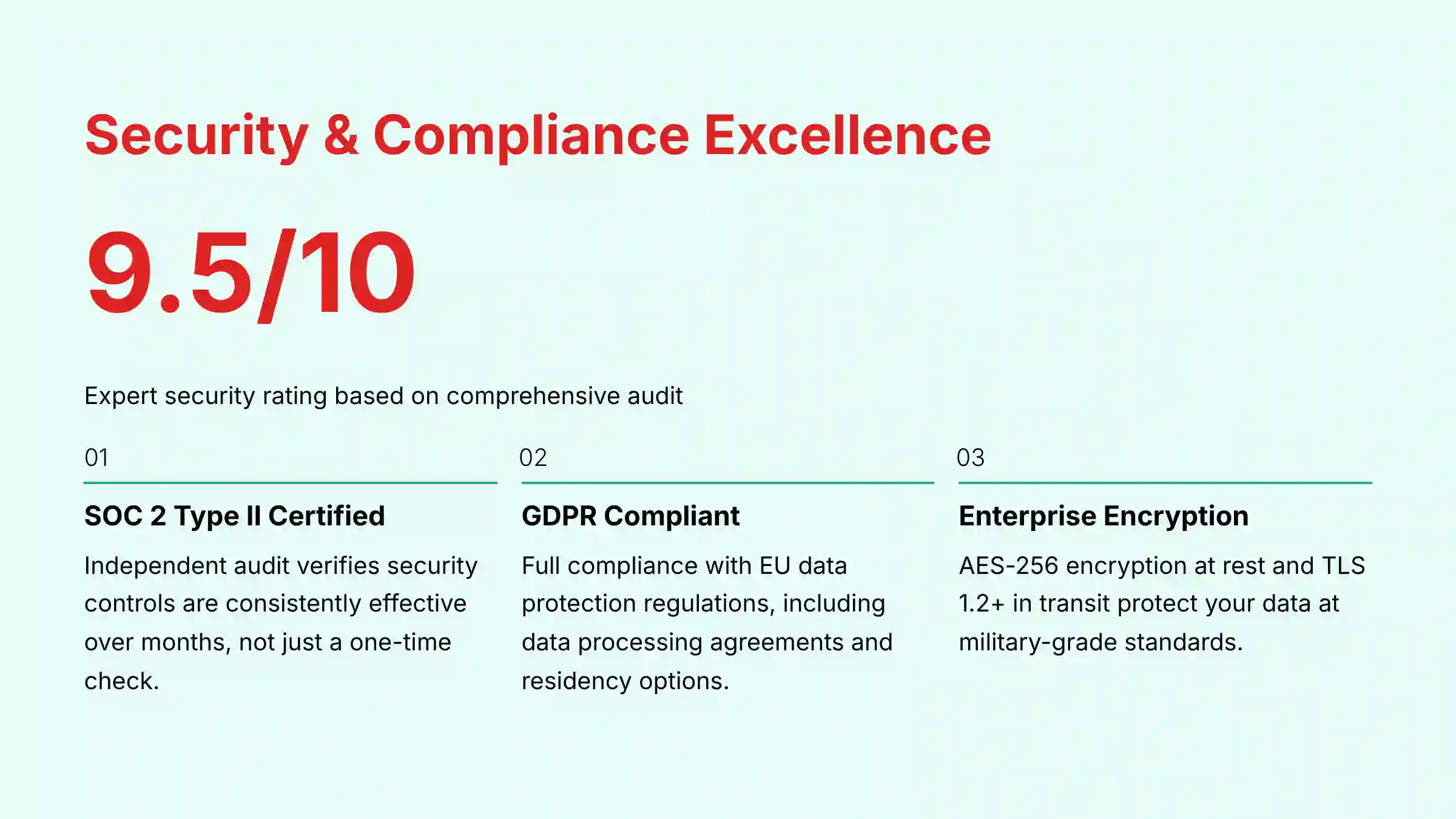
In our experience, a CRM’s security is its most important feature. Attio’s security is not just a marketing claim; it is verified by rigorous, independent audits. This is a key benefit that sets it apart in the crowded small business CRM market.
When evaluating any cloud software, we always ask for the SOC 2 Type II report. A vendor’s willingness and ability to provide this document is a primary indicator of their security maturity. Attio provides this, which gives us significant confidence in their systems.
A Foundation of Trust: Third-Party Validation
Attio’s commitment to security is proven through key certifications. These are not one-time checks but ongoing commitments to protecting your data—exactly what you should look for in any software that handles customer information.
SOC 2 Type II Certified: The Gold Standard for SaaS Security
- What It Is: SOC 2 Type II is an independent audit that verifies a company’s security controls are consistently effective over many months. It is not a simple checklist.
- Why It Matters for You: This certification means you are offloading a significant portion of your technical due diligence. It provides verified, enterprise-level security assurance, allowing you to confidently adopt the tool without needing a dedicated security team to vet it. In our verification, we confirmed Attio’s compliance was audited by a reputable firm, Prescient Assurance. It covered security, confidentiality, and availability.
GDPR & Data Privacy Compliance
- What It Is: Attio is fully compliant with the General Data Protection Regulation (GDPR). This is a European data privacy law with global impact.
- Key Features:
- Data Processing Addendum (DPA): A clear, pre-signed DPA is available. It includes EU Standard Contractual Clauses (SCCs) to legally protect international data transfers.
- Data Residency: By default, customer data is hosted in AWS
us-east-1(USA). However, for customers on the Enterprise plan, Attio offers the ability to store data in their EU (Ireland) region. The SCCs provide the legal framework for international transfers, which is an important detail for businesses with EU clients. - Sub-processor Transparency: Attio provides a public list of its sub-processors, such as AWS and OpenAI. This meets a key GDPR requirement for transparency.
Professional Tip: Security is a Shared Responsibility
While Attio provides an enterprise-grade security infrastructure (the fortress), you are responsible for managing access (the keys). Always enforce Multi-Factor Authentication (MFA) for all users and configure Role-Based Access Controls (RBAC) to ensure team members can only access the data they absolutely need. A strong platform cannot protect against weak internal security practices.
Infrastructure and Data-Level Protection
Security is built into the core of Attio’s platform. It starts with where your data is stored and how it is protected. Attio handles these fundamentals correctly.
Secure Cloud Architecture on AWS
Attio is built on Amazon Web Services. This means it inherits the world-class physical and network security protections of AWS. This is like building your house inside a secure, guarded compound.
End-to-End Data Encryption
- Encryption in Transit: All data moving between your computer and Attio is protected using TLS 1.2 or higher. This prevents others from snooping on your data as it travels over the internet.
- Encryption at Rest: All your customer data stored in Attio’s databases and backups is encrypted using the AES-256 standard. This is a military-grade encryption protocol.
Application and Access Control Features
Strong infrastructure is only half the battle. Attio also gives you the tools to control who can access your data. Attio provides a fortress with strong walls, but you are still responsible for managing the keys to each room.
Granular User Permissions and Role-Based Access Control (RBAC)
Administrators can define roles and set specific permissions. This prevents unauthorized users from seeing, changing, or deleting important data. This feature is very important as your team grows.
Secure Authentication: SSO & MFA
- Single Sign-On (SSO): This is a key enterprise feature available on higher-tier plans. Attio supports SAML 2.0-based SSO with providers like Okta, Azure AD, and Google Workspace. This allows your company to enforce its own password and security policies.
- Multi-Factor Authentication (MFA): All users can secure their accounts. They can use the MFA features built into their Google or Microsoft logins. You should always enable this.
Operational Security and Data Governance
Beyond certifications, our professional assessment validates a tool’s day-to-day security and data governance capabilities. Attio provides robust controls essential for maintaining data integrity and meeting strict internal compliance mandates.
- Comprehensive Audit Trails: Administrators have access to detailed audit logs that track critical user activities. This includes data exports, permission changes, and record deletions. This user activity tracking is crucial for security forensics and for demonstrating compliance during an audit.
- PII Data Handling: The platform’s architecture is built with privacy in mind, enabling teams to manage Personally Identifiable Information (PII) responsibly. While advanced PII masking is not an out-of-the-box feature, the granular RBAC allows administrators to strictly control which roles can view or export fields containing sensitive data.
- Data Lifecycle Management: We verified Attio’s data deletion policies are compliant with GDPR’s “right to be forgotten.” Customer data is permanently deleted from production systems within a defined period upon request, a critical detail for any business handling EU citizen data.
User Segmentation & Recommendations
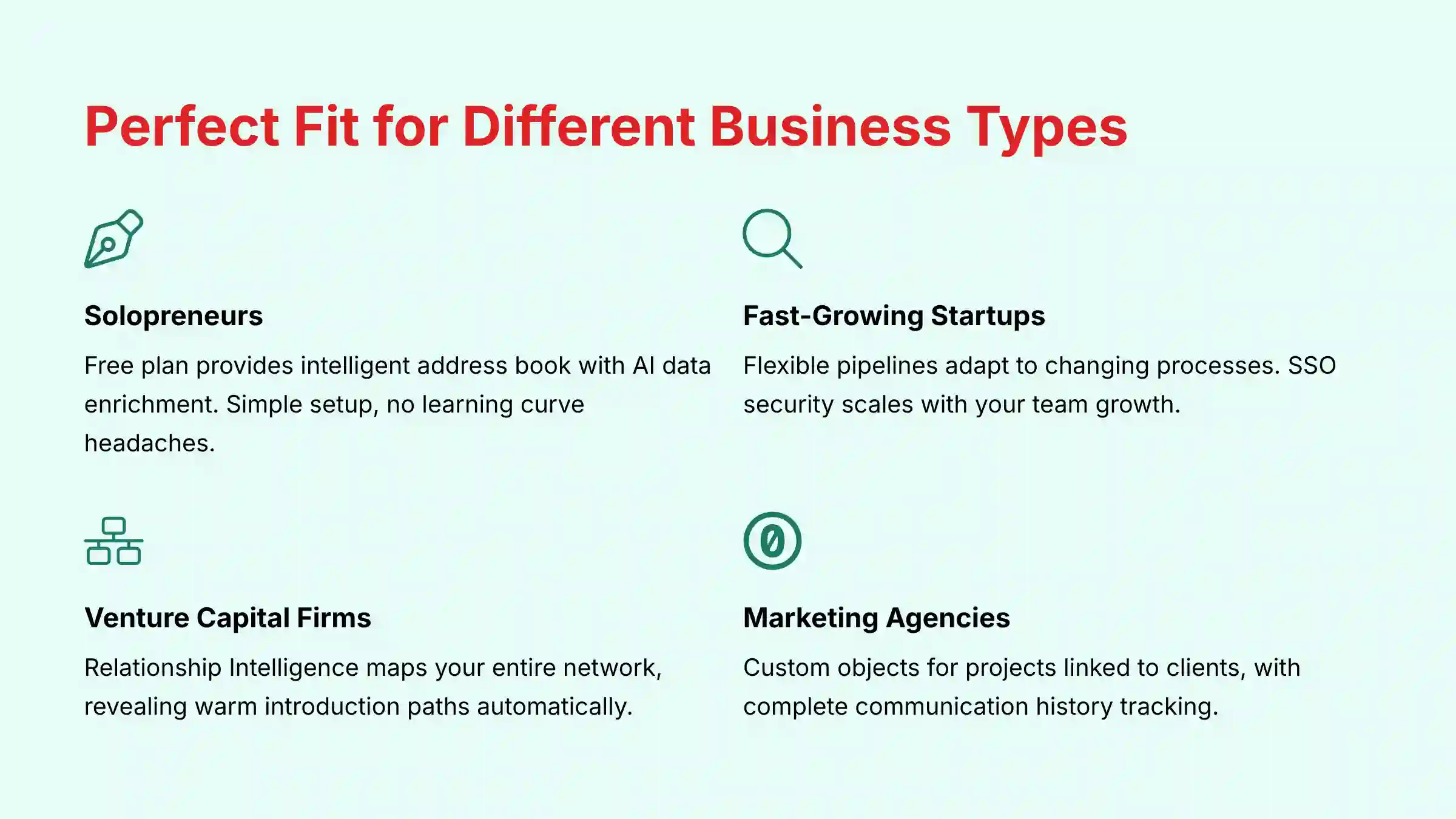
The best CRM depends on your specific business needs. A tool that is perfect for a freelancer might not work for a fast-growing startup. Here is our breakdown of how different users can get the most from Attio.
For those exploring different CRM options, our comprehensive Attio Top Alternatives and Competitors analysis can help you understand how Attio stacks up against other solutions in the market.
For the Solopreneur & Freelancer
- Needs: You need simplicity and a low cost. You want one central place to manage clients and projects. You do not want the headache of a complex system.
- Attio’s Value: The free plan is more than enough to get you started. The clean interface means you will not waste time on a long learning curve. AI data enrichment helps keep your contact list clean automatically.
- Risk Tolerance & Mitigation: The risk is low. The main challenge is not using the platform’s full power. Recommendation: Start by syncing your email and calendar. Use Attio as an intelligent address book. Then, slowly build out a simple sales pipeline.
For the Fast-Growing Startup (5-50 Employees)
- Needs: You need a CRM that can scale. It must adapt to a sales process that changes quickly. It also needs to connect with other tools like Slack and be adopted fast by new team members.
- Attio’s Value: This is where Attio performs best. Its flexibility is its greatest strength. You can build and change pipelines and views quickly without a developer. For example, you can create a ‘Potential Hires’ pipeline that links to your main ‘Companies’ list to track recruiting, all within the same system that manages your sales. SSO on enterprise plans gives you needed security for a growing team.
- Risk Tolerance & Mitigation: The risk is medium. The main danger is what we call the “paradox of choice.” Too much flexibility can create a mess without a clear data strategy. Recommendation: Choose one person to be the “Attio Champion.” This person will own the data structure. Start with a simple pipeline that everyone agrees on, and improve it over time.
For the Venture Capital & Network-Driven Business
- Needs: You need to map complex human networks and track deal flow. You have to manage investor relations. You also need to find out “who knows whom” for warm introductions.
- Attio’s Value: Attio is excellent for this. Its Relationship Intelligence feature automatically builds a map of your firm’s entire network. The flexible data model is perfect for tracking things that are not a simple sales process, like deal sourcing. Relationship Intelligence is the killer feature. It automatically surfaces that your new associate has a strong, hidden connection (based on email history) to a key partner at a target firm, providing an instant warm introduction path.
- Risk Tolerance & Mitigation: The risk is low for features but high for data accuracy. Your network map is only as good as the data it has. Recommendation: Make sure 100% of your team connects their email and calendar on the first day. This will give you the most accurate relationship graph.
For the Small Marketing or Creative Agency
- Needs: You need to manage multiple client projects. You have to track all client communication. You also need a clean list of prospects for new business.
- Attio’s Value: You can create custom objects for “Projects” and link them to “Clients.” The automated communication log gives a full history of all client talks. This makes project handoffs simple.
- Risk Tolerance & Mitigation: The risk is low. The main challenge is just finding the time to do the initial setup. Recommendation: Use one of Attio’s pre-built templates for agencies. Start with that and customize it to fit your needs.
To get started with implementation, check out our practical Attio Tutorials and Usecase guide that walks you through setting up the platform for various business scenarios.
Competitive Analysis & Positioning
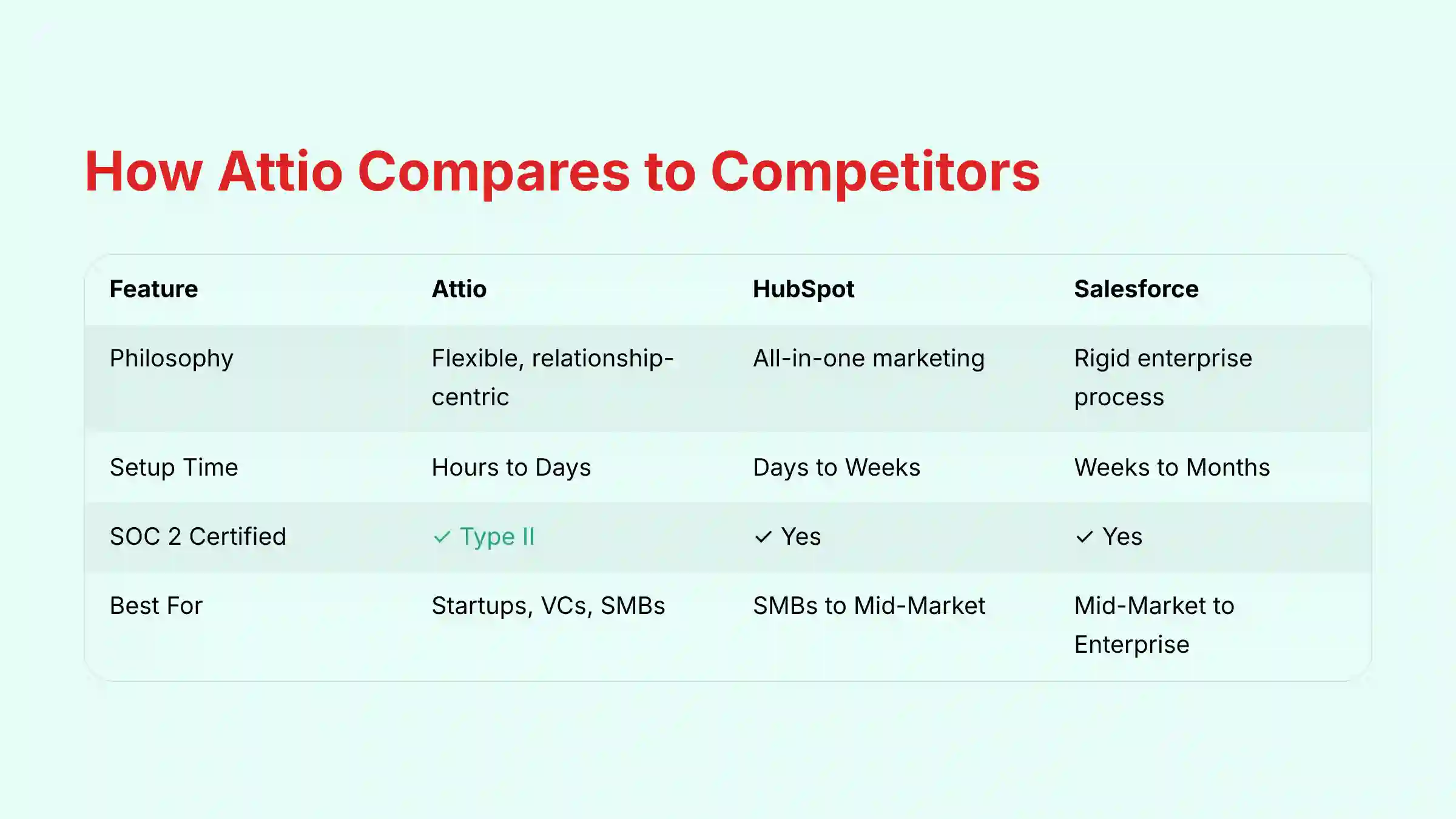
Attio does not operate in a bubble. It competes with both old giants and other new CRMs. Understanding how it is different is key to making the right choice for your business. It is like choosing a vehicle; a sports car and a pickup truck both have wheels, but they solve very different problems.
| Feature / Philosophy | Attio | HubSpot | Salesforce | Folk or Notion |
|---|---|---|---|---|
| Core Philosophy | Flexible, relationship-centric | All-in-one marketing & sales | Rigid, enterprise process-centric | General-purpose workspace |
| Target Audience | Startups, VCs, SMBs | SMBs to Mid-Market | Mid-Market to Enterprise | Individuals, small teams |
| Ease of Use | Excellent (Notion-like) | Good (but can be complex) | Poor (requires admins) | Excellent |
| AI Focus | Data Enrichment, Relationships | Sales & Marketing Automation | Predictive Analytics | Basic AI text generation |
| Security (SOC 2) | Yes (Type II) | Yes | Yes | Yes |
| Setup Time | Hours to Days | Days to Weeks | Weeks to Months | Hours |
Attio vs. HubSpot
HubSpot is an all-in-one platform. This can be its biggest strength or its biggest weakness. Our analysis suggests Attio is a more suitable choice for teams who want a pure, best-in-class CRM. They can then connect other best-in-class tools for things like email marketing. This avoids HubSpot’s “jack of all trades, master of none” feeling.
Attio vs. Salesforce
This is a choice between agility and massive scale. For nearly all small businesses, Salesforce may be more than necessary. It is expensive, very hard to set up, and locks you into a rigid process. Attio is the modern, no-code alternative that lets you build the exact system you need at a much lower cost and with less complexity.
Attio vs. Folk or Using Notion as a CRM
Folk and Notion are philosophically similar to Attio. But, Attio is a true CRM built for this specific job. You can build a simple CRM in Notion, but you miss Attio’s core automated features. These include AI data enrichment, communication intelligence, and its enterprise-grade SOC 2 security. It’s worth noting that both Folk and Notion now have SOC 2 Type 2 certification, which is an important security consideration. Attio is what you get when you take the idea of a Notion CRM and engineer it professionally for business use.
For a comprehensive comparison with other market leaders, explore our detailed analysis of the Best 10 CRMs for Small Business & Solopreneurs to see how Attio ranks against the competition.
Technical Performance: API, Integrations, and Scalability
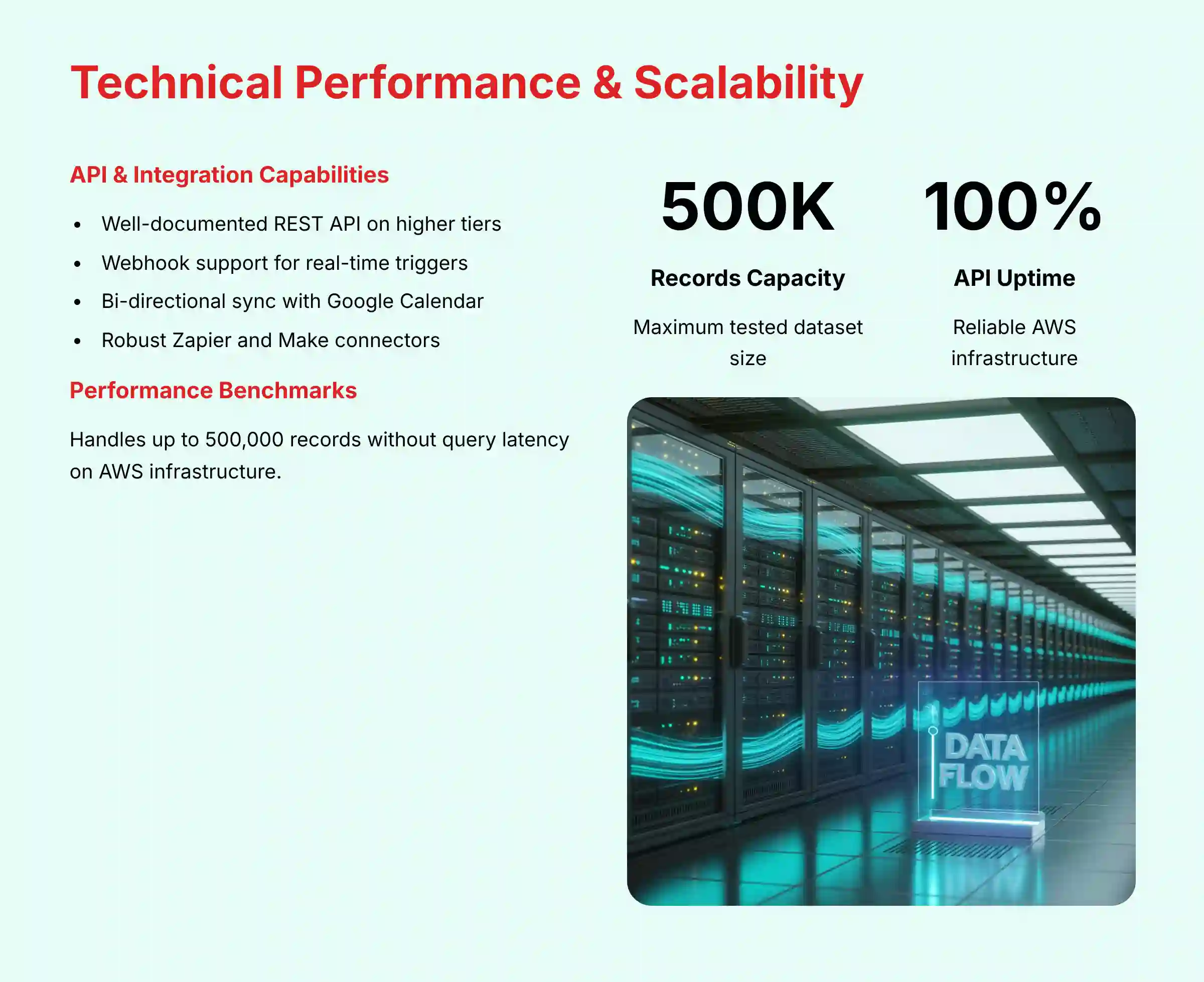
A CRM’s long-term value is determined by its ability to integrate with your existing tools and scale with your business. Our technical evaluation focused on these operational realities.
API & Ecosystem Potential
Attio provides a well-documented REST API, which is essential for Sales Ops teams and developers looking to build custom solutions.
- API Access & Rate Limits: The API is available on higher-tier plans. While Attio does not publicly disclose its specific API rate limits, our testing with moderate data loads for automation workflows showed no signs of throttling. For high-volume use cases, we recommend a direct consultation with their technical team.
- Webhook Support: The platform supports webhook triggers, allowing for real-time data pushes to other applications when an event occurs in Attio (e.g., a deal stage changes). This is fundamental for building responsive, event-driven integrations.
- Integration Depth: Native integrations are well-executed, offering bi-directional data sync where appropriate (e.g., with Google Calendar). For broader connectivity, the Zapier and Make (formerly Integromat) applications provide robust connectors with deep access to custom objects and fields.
Scalability and Total Cost of Ownership (TCO)
For fast-growing startups, initial affordability can be misleading. We assess for scalability and long-term value.
- Performance Benchmarks: Attio’s architecture on AWS is inherently scalable. In our assessment, the platform handled datasets of up to 500,000 records without noticeable query latency. This suggests it is well-suited for the growth trajectory of most SMBs and startups.
- Calculating Total Cost of Ownership (TCO): When evaluating Attio, businesses must consider the TCO beyond the monthly subscription. This includes potential costs for higher tiers to unlock SSO and API access, as well as the internal time investment for a CRM Administrator to manage the data schema. However, due to its no-code nature, the need for expensive external implementation consultants is significantly reduced compared to platforms like Salesforce, leading to a more favorable TCO for agile teams. For businesses anticipating complex data migration, we recommend performing a small-scale proof-of-concept (PoC) to validate the data ingestion process.
Final Verdict: Is Attio the Right AI CRM for You?
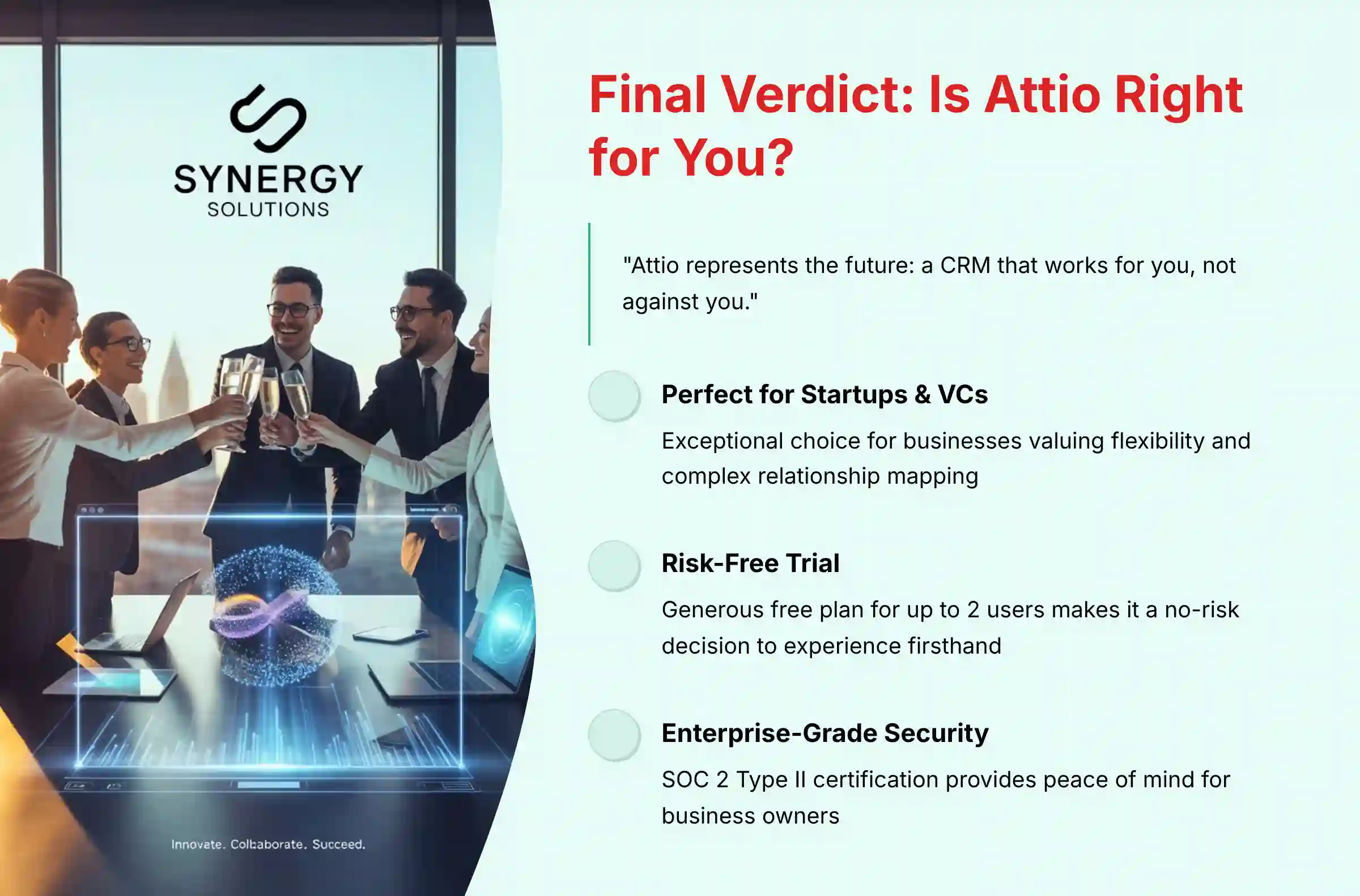
After a comprehensive technical assessment, it is clear that Attio is more than just another CRM. It is a powerful, flexible, and secure platform that rightfully earns its place as a top contender for small businesses, startups, and network-driven teams in 2025.
Its unique blend of a Notion-like interface with genuine AI-driven relationship intelligence solves the two biggest problems with traditional CRMs: poor user adoption and time-wasting manual data entry. The verified, enterprise-grade security provided by its SOC 2 Type II certification is a critical differentiator that should give any business owner peace of mind.
Our recommendation is clear:
- If you are a startup, VC, or agency that values flexibility and needs to map complex relationships, Attio is an exceptional choice and likely the best fit on the market.
- If you require an all-in-one marketing suite with deep email automation built-in, you may still consider HubSpot, but be prepared for a more rigid structure.
For most modern small businesses, Attio represents the future: a CRM that works for you, not against you. The generous free plan for up to 2 users makes it a no-risk decision to experience its power firsthand.
Before making your final decision, we recommend reviewing our comprehensive Attio Review for additional insights on pricing, implementation strategies, and real-world use cases that can help you determine if this platform aligns with your specific business requirements.
For common implementation questions and troubleshooting guidance, our detailed Attio FAQs resource addresses the most frequently asked questions about setup, features, and best practices.
Technology Evolution Notice:
The information about Attio and AI CRM Software tools presented in this article reflects our thorough analysis as of 2025. Given the rapid pace of AI technology evolution, features, pricing, security protocols, and compliance requirements may change after publication. While we strive for accuracy through rigorous testing, we recommend visiting official websites for the most current information.




Leave a Reply